
Quick Answer: What Is the Easiest Way to Visit Cheonggyecheon?
If it's your first time in Seoul, Cheonggyecheon is way easier than you'd think. It's not a hidden mountain trail — it's an 11km urban stream running straight through downtown, fully restored in 2005 after being covered with concrete in the 1950s-60s. Back in Joseon era, this was a real-life stream where locals washed clothes and kids played. During industrialization it got paved over and became a noisy overpass, then Mayor Lee Myung-bak's team tore it all down and brought the water back. That's why today you get this weird, lovely mix of nature and skyscrapers.
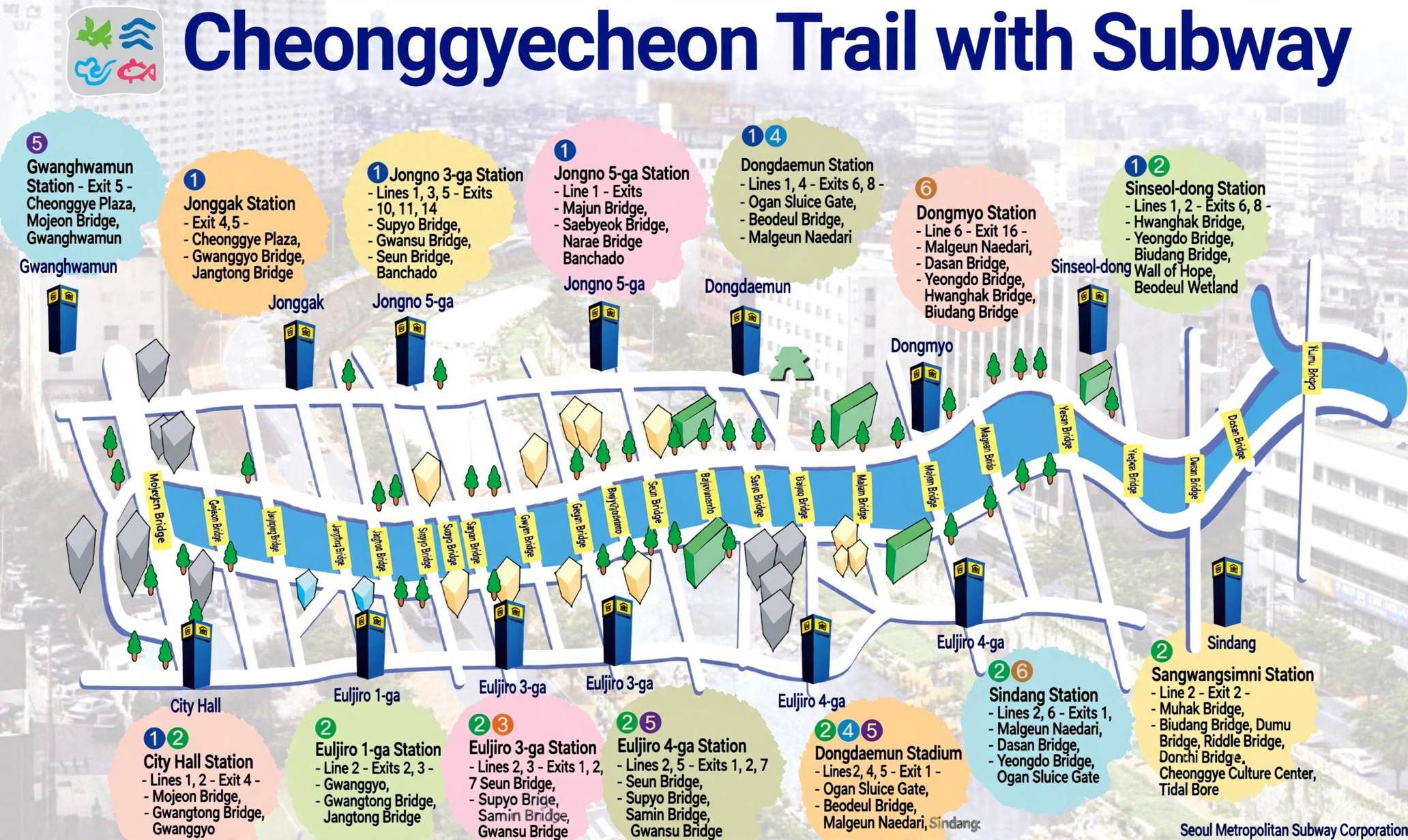
The absolute easiest way? Start at Cheonggye Plaza. Take Subway Line 5 to Gwanghwamun Station, Exit 5 — walk straight for like 2 minutes and boom, you'll see the famous Spring sculpture (that twisty snail-shell tower) and the big open plaza. That's the official Day 1 spot. If you're coming from City Hall area, take Line 1 or 2 to City Hall Station Exit 4 and walk 5 minutes north toward Sejong-daero — you'll see signs for Cheonggyecheon everywhere.
Don't wanna start at the very beginning? Totally fine. For the middle section, use Line 1 Jonggak Station Exit 5 — you'll pop out right by Gwangtonggyo, one of the oldest bridges with that historic stone vibe. Or Line 2 Euljiro 1-ga Station Exit 2, walk toward Jongno and you'll hit the trail in 3 minutes. That's perfect if you're planning to eat in Euljiro first.
Exits are super flexible — every 200m there's stairs or a gentle ramp back up to street level, so you never feel trapped. If you keep walking east toward Dongdaemun, you'll hit Ogansugyo Bridge, which connects directly to DDP (Dongdaemun Design Plaza) in like 10 minutes. From there you can keep going to Seoul Forest or just hop on the subway.
For rest, Cheonggye Plaza's fountain is your best friend in summer — cool water, sculptures, lots of shade. My fave is Gwanggyo Gallery and the stepping stones nearby. That's where you'll see office workers dipping their feet, couples crossing the stones for photos, and that shaded walk under the buildings where everyone just chills. Food-wise, Gwanghwamun and Jonggak have everything from Korean BBQ to casual cafes with English menus and proper chairs (not just floor seating), and Euljiro is packed with local eateries where solo travelers won't feel weird — counter seats, fast service, super friendly.
Need translation for "Cheonggyecheon" and "Gwanghwamun"?
In Chrome, right-click and choose Translate to your language.
如果您需要中文,请在Chrome中右键点击并选择翻译成中文。
Chromeで右クリックして日本語に翻訳を選択してください。
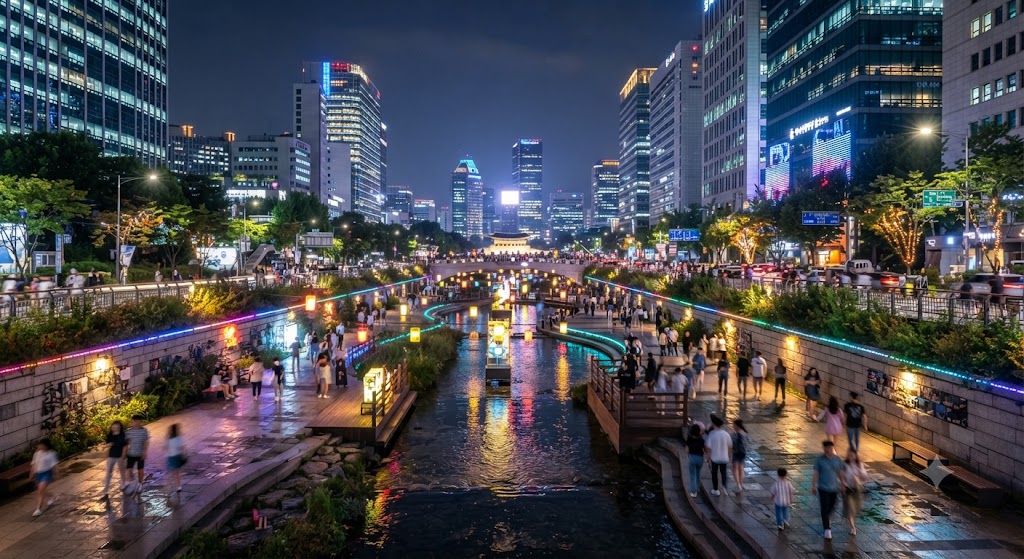
Brief History of Cheonggyecheon
Cheonggyecheon wasn't always this pretty Instagram spot. For over 600 years during Joseon Dynasty, it was Seoul's main stream — people did laundry here, kids caught minnows, markets popped up on the banks. After the Korean War in the 1950s-60s, Seoul grew crazy fast. The stream got polluted, people built shacks over it, and the city covered the whole thing with concrete and built an elevated highway on top. For 40 years, you couldn't even see water.
Then in 2003, then-Mayor Lee Myung-bak said let's tear it all down. It was a massive, controversial project — 2 years, $900M-ish, 11km of stream restored from Cheonggye Plaza to near Seoul Forest. They brought back clean water pumped from the Han River, rebuilt 22 historic bridges like Gwangtonggyo and Supyogyo, and turned it into a public walkway 3-4 meters below street level. Now it's one of the rare urban renewal cases that actually worked. You'll still see the old stone markers showing where Joseon measured water levels.
How to Visit: Entrance & Exit Guide Overview
The beauty of Cheonggyecheon is you don't need tickets, reservations, or a guide. It's open 24/7, free, lit at night till 11pm-ish. But for foreigners, the subway exit numbers matter a lot — Seoul's exits can dump you 300m away if you pick wrong. So here's the breakdown I've tested with 30+ friends.
Start: Cheonggye Plaza Entrance via Gwanghwamun & City Hall
The most foolproof first-time entrance
Cheonggye Plaza is the official kilometer zero. You'll know you're there when you see Spring — that 20m tall spiral sculpture that looks like a snail or a spring, meant to symbolize the rebirth of the stream. Right behind it is a big open plaza with a model of the whole stream.
- Gwanghwamun Station Line 5 Exit 5: Come out, turn right, walk straight 150m. You can't miss it. This exit has an escalator and is stroller-friendly. The first 100m after entering is the most crowded — everyone takes photos at Spring.
- City Hall Station Line 1/2 Exit 4: Walk north 5 min toward Sejong-daero, you'll see Cheonggye Plaza signs in English. Good if you're coming from Seoul Plaza or Deoksugung.
- Pro tip: There's a gentle ramp down, not just stairs, so wheelchairs and luggage are fine. At the bottom there's drinking fountains and a small tourist info booth (English ok).
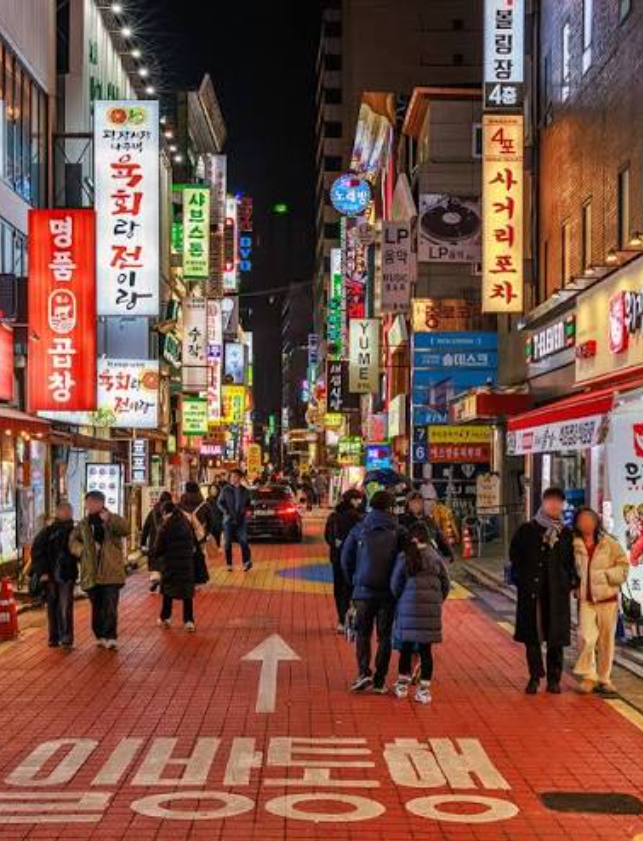
Middle Entries: Jonggak & Euljiro
If you're staying in Jongno or Euljiro, don't backtrack to Cheonggye Plaza. Jump in the middle — it's way less crowded and you get straight to the pretty parts.
Jonggak & Euljiro entrances that locals use
- Line 1 Jonggak Station Exit 5: This is my go-to. You exit, walk 30 seconds, and you're at Gwangtonggyo — that historic wide bridge from Joseon with engraved turtles. There's a stair down right under the bridge. You instantly feel like you're in old Seoul.
- Line 2 Euljiro 1-ga Station Exit 2: Exit 2, walk toward Jongno-gu office (Jongno direction) for 2-3 min. You'll see Cheonggyecheon trail signs. This entry lands you near Sampoonggyo where the famous wall art is.
- What you'll see: Less touristy, more office workers on lunch break. Perfect for photos without 50 people in the frame.
Exits and How to Move to DDP
You're never stuck down there. Every 200-300m there's a staircase or slope up to the street. Signs say which road you're going up to — Jongno, Euljiro, etc. So you can walk 10 minutes, pop up for coffee, come back down.
If you keep walking east, after about 40 min from Cheonggye Plaza you'll hit Ogansugyo Bridge — that's the gateway to Dongdaemun. Go up here, walk 10 min north and you're at DDP (Dongdaemun Design Plaza), Zaha Hadid's spaceship building. You can also continue all the way to Seoul Forest if you want a long 2-hour urban hike. My suggestion for first-timers: walk Cheonggye Plaza to Gwanggyo (20 min), exit at Jonggak, grab lunch, done. No need to marathon the whole 11km.
Best Rest Spots: Plaza Fountain & Gwanggyo Gallery
Seoul gets humid in summer, so rest spots matter. Cheonggye Plaza's fountain shoots cool mist — in July, office workers sit with their feet near the water, kids splash. It's loud, bright, perfect for a first 5-min break.
My favorite is around Gwanggyo (that modern glass bridge) — there's Gwanggyo Gallery, a tiny exhibition under the bridge showing Cheonggyecheon history, and right next to it the famous stepping stones. You can hop across the stream, take that classic photo with skyscrapers behind you. The area under the buildings creates natural shade, so even at 2pm it's cool. You'll see couples, solo readers, ajummas chatting. There are stone benches every 50m, but they get hot in sun — grab shade.
Food Near Gwanghwamun, Jonggak, Euljiro
You will get hungry. Good news: all three zones are office districts, so lunch options are endless and surprisingly foreigner-friendly.
- Gwanghwamun & Jonggak area: Diverse — Korean BBQ, bibimbap, casual pasta. Many places now have multilingual menus (EN/JP/CN) and chair seating, not floor. Try Gwanghwamun Jip for kimchi jjigae set (7,000-9,000 KRW), or the cold noodle alley near Jonggak Station Exit 4 for naengmyeon. Solo-friendly counters are common.
- Euljiro area: This is the hipster comeback zone. Old printing shops turned into cafes and pocha. Eulji Darak for retro vibe and coffee, Euljiro Pocha alley for skewers and beer after your walk. Office-worker lunch spots do super fast Korean home meals — 6-8 dishes for 8k won. Most have ticket machines with pictures, so pointing works.
- Solo travel tip: Look for counter seats (다찌) or "honbap" signs — means solo dining welcome. Don't feel awkward; half of Euljiro eats alone at lunch.
🗼 3 Must-Know Korean Phrases for You
1. How do I get to Cheonggyecheon?
청계천에 어떻게 가요?
Cheonggyecheone eotteoke gayo?
2. Where is the rest area?
휴식 공간 어디예요?
Hyusik gonggan eodiyeyo?
3. Please recommend a nearby restaurant
근처 식당 추천해 주세요
Geuncheo sikdang chucheonhae juseyo
Conclusion & Summary
Cheonggyecheon is Seoul's easiest green escape — you don't need to plan a whole day. For first-timers, just remember: start at Cheonggye Plaza via Gwanghwamun Exit 5 or City Hall Exit 4, dip in mid-way at Jonggak Exit 5 or Euljiro Entrance Exit 2 if you want food first, and exit anytime via stairs to pop up to DDP through Ogansugyo. Rest at the plaza fountain and Gwanggyo stepping stones where locals actually hang out, and eat around Gwanghwamun-Jonggak-Euljiro where solo dining is totally normal. It's free, open late, and the best way to feel both historic and super modern Seoul in 30 minutes.
1. Start at Cheonggye Plaza — Gwanghwamun Exit 5 / City Hall Exit 4 is the easiest first entrance.
2. Use middle entries Jonggak Exit 5 (Gwangtonggyo) & Euljiro Entrance Exit 2 for food + less crowd; exit anywhere via stairs/ramp to DDP via Ogansugyo.
3. Rest at plaza fountain & Gwanggyo gallery stepping stones; eat solo-friendly around Gwanghwamun Jonggak Euljiro with multilingual menus.
About Author
Seoul local for 12 years, licensed tour interpreter (English). I've walked Cheonggyecheon over 400 times with friends, family, and small groups. I focus on subway-level details foreigners actually need — exit numbers, ramp locations, solo-friendly food spots.
Sources: Seoul Metropolitan Government Cheonggyecheon restoration archive [1], Seoul Metro exit map [2], field notes 2016-2024.
Next post: How I Enjoyed Euljiro and Jonggak After Cheonggyecheon Walk: Cafe and Pocha Guide
Need translation?
In Chrome, right-click → Translate to your language. For offline copy, use HTML 복사 button above — it copies clean inline-style HTML that works in Blogspot without breaking.
https://minaleedaddy.tistory.com/59
How to Spend 2 Days in Seoul Solo: Palaces, Markets & Hongdae Guide
A complete guide to Seoul for solo travelers covering royal palaces, traditional hanok alleys, street markets and vibrant youth districts in 2 days.This guide is for foreign tourists who are curious about Seoul solo itinerary 2 days, Gyeongbokgung palace h
minaleedaddy.tistory.com