Quick Answer: Navigating the Seoul Subway is remarkably efficient once you secure a Tmoney card from any convenience store and download Naver Map for real-time routing. Fares start at around 1,400 KRW, and you enjoy free transfers between subways and buses within 30 minutes by simply tapping your card when entering and exiting.
如果您需要中文,请使用上方的谷歌翻译器(Translate)翻译成中文查看。首尔地铁 tourist 乘车指南与换乘优惠攻略。
日本語が必要な場合は、上のGoogle翻訳(Translate)を使って日本語に翻訳してご覧ください。ソウル地下鉄의 乗り方, Tmoneyカード, 乗換割引の解説。
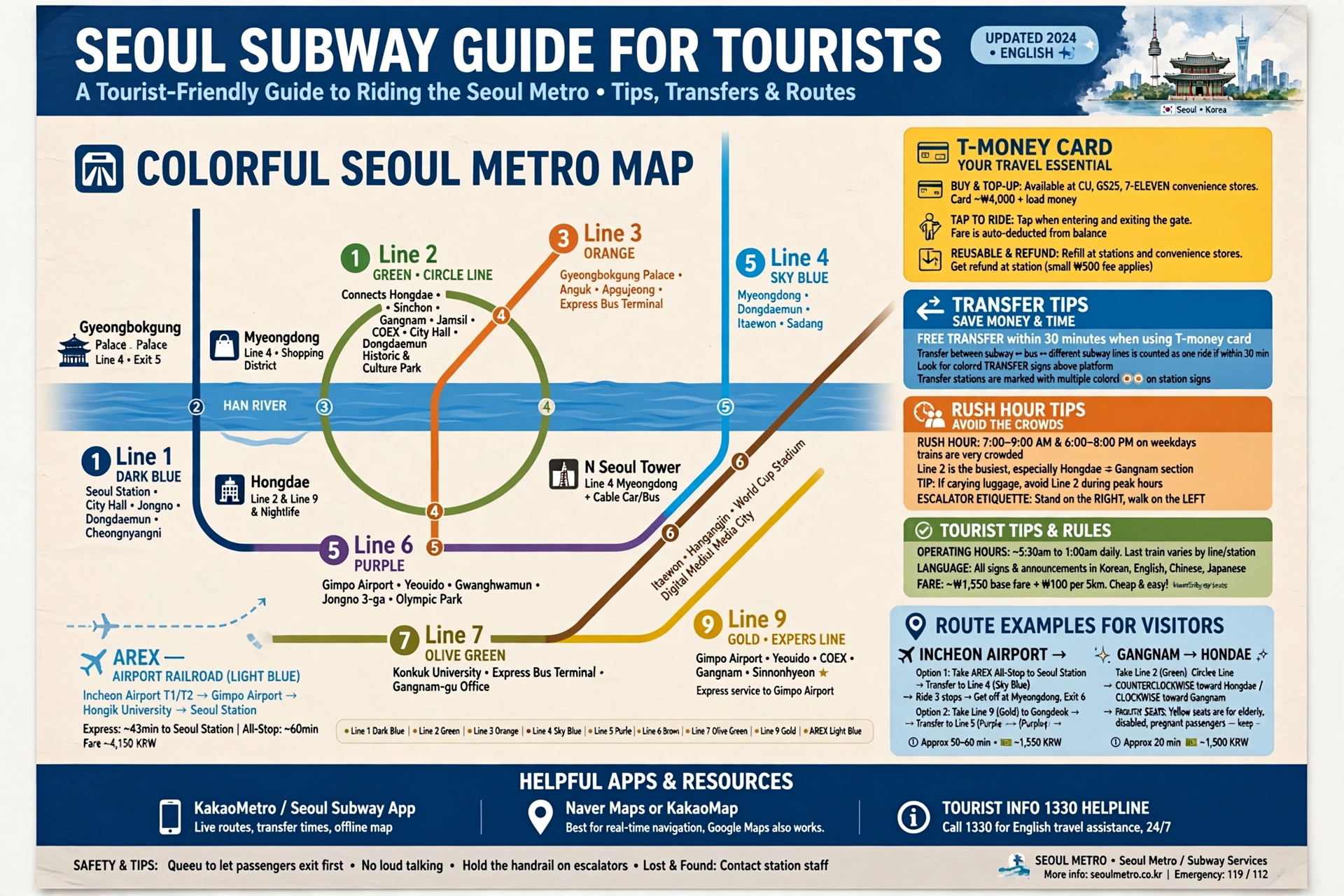
1. Introduction: Unlocking Seoul Through Its Legendary Subway System
Stepping into a massive foreign metropolitan transit network for the first time can easily induce a sense of intimidation. When you look at the sprawling color-coded spiderweb of the Seoul Subway system, complete with dozens of intersecting lines and hundreds of stations, it is natural to feel a moment of hesitation. However, once you understand the underlying logic of how Seoul manages its public transit, you will quickly realize that it is one of the cleanest, most punctual, and most user-friendly subway networks in the entire world. Whether you are zipping from Hongdae's indie art cafes to Gangnam's high-end commercial avenues, the subway is your ultimate key to unlocking the city without getting bogged down in notorious traffic jams.
In this comprehensive guide, we will break down everything you need to know from the moment you land at Incheon Airport—securing your essential transit card, bypassing inadequate global mapping tools, decoding color-coded lines, mastering transfer discounts, and observing local platform etiquette. With this field-tested roadmap in hand, you will ride the rails through Seoul with the confidence of a seasoned local resident.
2. Getting Started: Securing and Topping Up Your Tmoney Card
One of the most common beginner mistakes international travelers make is attempting to purchase single-journey paper tickets for every individual trip. Not only is this tedious and time-consuming, but it also incurs small extra deposits and administrative fees. The golden rule of travel in Seoul is simple: get a Tmoney Card immediately upon arrival.

Tmoney Card Essentials:
- Where to Buy: Pick up a standard Tmoney card at any convenience store (such as 7-Eleven, CU, or GS25) right at Incheon Airport or scattered across every street corner in the city. You can also find fun, character-branded collectible cards at pop-up stores.
- How to Top Up: Load your card using physical Korean Won cash at convenience store counters or self-service ticket vending and refilling machines located inside every subway station.
- Versatility: Beyond subways and buses, your Tmoney card can be used to pay for taxi fares, convenience store purchases, and even lockers.
3. Essential Apps: Why Naver Map Beats Google Maps in Korea
Before you even step foot onto a train platform, you must adjust your digital navigation habits. Due to national security regulations governing local mapping data and geospatial servers, **Google Maps does not provide accurate public transit routing or turn-by-turn walking directions** within South Korea. While Google can show you global landmark locations, it will often leave you stranded when trying to calculate subway transfers.
Instead, download these English-friendly domestic powerhouses before your trip:
Comparative Overview: Essential Korea Transit Apps
| App Name | Primary Function | Why You Need It |
|---|---|---|
| Naver Map / KakaoMap | Comprehensive Navigation | Provides real-time subway routes, exact transfer car recommendations, and walking paths. |
| Subway Surf / KakaoMetro | Dedicated Rail Timetables | Offers offline station maps, exact train schedules, and rapid transfer station diagrams. |
| KakaoBus | Bus Tracking Companion | Tracks live bus arrivals when pairing bus segments with your subway journey. |
App Pro-Tip:
- Naver Map features an English interface option that translates station names and provides precise walking durations between platform transfers.
4. Step-by-Step Guide: How to Ride the Seoul Subway
Riding the subway is a straightforward, intuitive process once you understand the four fundamental steps of boarding and alighting.
- Step 1 (Tap In): Approach the turnstile gates and tap your Tmoney card firmly against the digital sensor pad. The gates will open instantly, and the display will show your remaining card balance.
- Step 2 (Find Your Platform): Follow overhead signs displaying your target line's distinct color and number. All major signage across Seoul's transit hubs is meticulously written in English, Korean, Chinese, and Japanese.
- Step 3 (Check the Direction): Before stepping onto the platform, inspect the wall-mounted or digital hanging signs indicating the next major terminal stations on that specific route to ensure you are heading in the right direction.
- Step 4 (Tap Out): Upon reaching your destination station, tap your card again at the exit turnstile. (Be mindful not to accidentally exit through wide luggage gates unless necessary, though standard gates accommodate most backpacks and rolling bags).
5. Decoding Lines, Fares, and Transfer Discounts
Understanding the structural anatomy of the Seoul Subway network helps you plan efficient routes across the metropolis. Every individual line is assigned a clear, distinct color and numerical identifier (e.g., Line 1 is Dark Blue, Line 2 is Green). Among them, **Line 2** is particularly famous as a circular loop line connecting major tourist hubs like Hongdae, Sinchon, Dongdaemun, and Gangnam.
Furthermore, public transit in Seoul is remarkably affordable. A standard basic one-way fare starts at a modest 1,400 KRW (roughly $1.05 USD) for short distances. Even better, Seoul offers a fantastic **free transfer discount** system: if you transfer between subways and local city buses (or vice versa) within 30 minutes of tapping out (extended to 60 minutes during nighttime hours), your connecting ride is completely free, provided you remember to tap your card on the sensor when boarding and alighting every vehicle!
6. Important Subway Etiquette Rules to Keep in Mind
Korean public transportation culture places a strong emphasis on mutual consideration and orderly behavior. Keeping a few unwritten etiquette rules in mind ensures a harmonious journey:
- Escalator Protocol: Stand firmly on the right side of escalators to allow rushing commuters to walk freely up the left side.
- Priority Seating: Avoid sitting in the designated priority seats located at either end of every subway car. These are strictly reserved for senior citizens, pregnant women, and passengers with disabilities, even when the train is packed and the seats appear empty.
- Acoustic Courtesy: Keep telephone conversations brief and subdued, and always use headphones when listening to music, watching videos, or playing games on your mobile device.
Interactive Survival Korean & Browser TTS Toolkit
When asking station staff for assistance or navigating transfers, these three essential phrases will bridge any communication gap instantly. Click the '▶ Listen' buttons below to practice accurate native pronunciation using your browser's audio engine.
1. Where is the subway station?
지하철역이 어디에 있나요?
Jihachulyeog-i eodie issnayo?
2. How do I get to this station?
이 역은 어떻게 가나요?
I yeog-eun eotteoke ganayo?
3. Where is the transfer gate?
환승 통로는 어디인가요?
Hwanseung tongnoro-eun eodiingayo?
Seoul Station Central Transit Hub Map
Use the interactive map below to explore central Seoul transit connections and station positioning.
Conclusion & Summary
Core Summary:
- Purchase and top up a physical Tmoney card at any convenience store for seamless subway and bus riding.
- Download Naver Map or KakaoMap to bypass Google Maps limitations and access real-time transit routing.
- Enjoy budget-friendly fares starting at 1,400 KRW along with free transfer discounts within 30 minutes.
Sources & References:
- Seoul Metropolitan Government Public Transportation & Subway Archives
- Korea Transportation Safety Authority Transit Guidelines
Compliance Note: This guide is independently curated for educational and practical reference to assist international tourists navigating South Korea.
http://www.seoulmetro.co.kr/en/cyberStation.do
Cyber Station in Seoul Metro
Day Select Weekdays Saturday Sunday Hour Select 00 01 02 03 04 05 06 07 08 09 10 11 12 13 14 15 16 17 18 19 20 21 22 23 min Select 00 01 02 03 04 05 06 07 08 09 10 11 12 13 14 15 16 17 18 19 20 21 22 23 24 25 26 27 28 29 30 31 32 33 34 35 36 37 38 39 40 41
www.seoulmetro.co.kr