
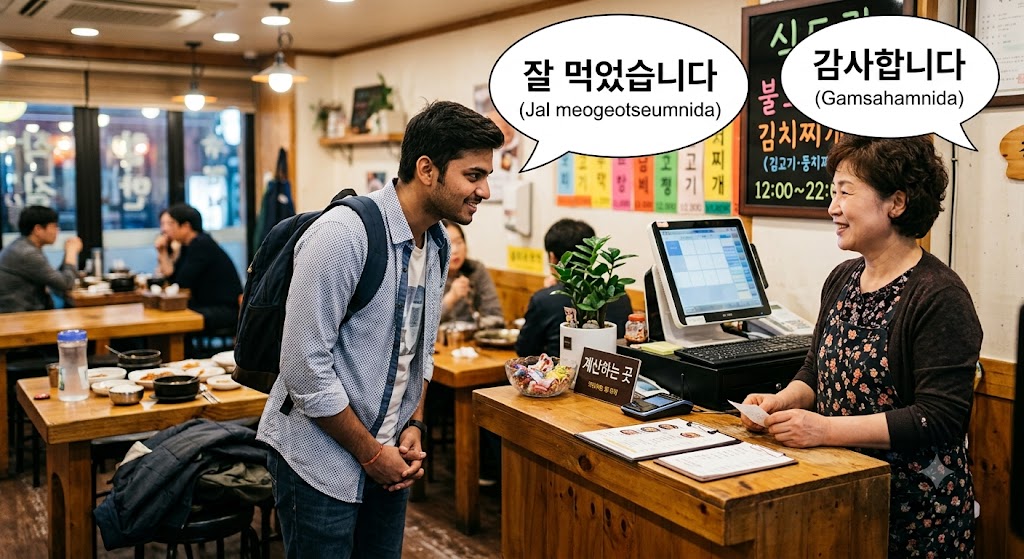
Ever noticed how Koreans bow a little differently to everyone? That's not random. In Korea, your greeting shows your manners in 3 seconds. Nail it, and even the busiest convenience store clerk will smile back.
I've lived in Seoul for years and watched many travelers feel awkward just because they didn't know the bow depth or when to say what. So I made this super practical version.
The Basics Most Guides Don't Tell You
Korean greetings have 3 hidden rules: Angle, Hands, Eyes.
- Angle: 15° for daily life, 30° for thanks, 45° for elders/sincere apology.
- Hands: Never in pockets. Put them neatly in front or hold your bag with both hands.
- Eyes: Don't stare. Soft gaze at chin/nose level = polite.
5 Situations You Will Face Every Day
1) Meeting Someone First Time
Hotel, cafe, guesthouse. Use 안녕하세요? (Annyeonghaseyo?) with a light 15° bow. Add 처음 뵙겠습니다 (Cheoeum boepgesseumnida) if you want extra respect.
2) Saying Thanks
Use 감사합니다 (Gamsahamnida) for formal, 고맙습니다 (Gomapseumnida) for warm. The second one sounds more heartfelt to older Koreans.
3) At Restaurants - The Hidden Etiquette
Before eating: 잘 먹겠습니다 (Jal meokgesseumnida) / After: 잘 먹었습니다 (Jal meogeotseumnida). It's not just "thanks" — you're honoring the cook's effort. Staff love it.
4) Passing Through Crowds
Seoul subway at 6pm is war. Use 실례합니다 (Sillyehamnida) to get through, 죄송합니다 (Joesonghamnida) when you actually bump someone. Don't mix them!
5) Leaving
If YOU leave: 안녕히 계세요 (Annyeonghi gyeseyo) / If THEY leave: 안녕히 가세요 (Annyeonghi gaseyo). Too confusing? Just say "감사합니다, 좋은 하루 되세요!" Works everywhere.
🤝 Senior & Gender Etiquette: What Tourists Get Wrong
- For seniors (60+): Bow deeper (30-45°), use two hands for handshake. One hand = rude.
- Young slang (only for friends): 안녕! (Annyeong), 하이! (Hi), 오랜만! (Long time no see)
- Male tourists → Female locals: No hugging, no cheek kiss, no shoulder touch on first meeting. Keep one arm distance, light bow. If she offers handshake, respond with two hands lightly.
▶ Open Survival Phrases APP
1. Hello (Polite - Anyone, Anytime)
안녕하세요.
Annyeonghaseyo.
2. Nice to meet you
만나서 반가워요.
Mannaseo bangawoyo.
3. It's my first time meeting you (Very Polite)
처음 뵙겠습니다.
Cheoeum boepgetseumnida.
4. Please take care of me (Essential for business)
잘 부탁드립니다.
Jal butakdeurimnida.
5. Thank you (Standard Polite)
감사합니다.
Gamsahamnida.
6. I'm sorry (For mistakes)
죄송합니다.
Joesonghamnida.
7. Goodbye (You are staying, they are leaving)
안녕히 가세요.
Annyeonghi gaseyo.
8. Goodbye (You are leaving, they are staying)
안녕히 계세요.
Annyeonghi gyeseyo.
9. How have you been? (Warm greeting)
잘 지내셨어요?
Jal jinaesyeosseoyo?
10. See you again soon! (Leaves great impression)
다음에 또 만나요!
Daeume tto mannayo!
| Situation | Phrase | Bow |
|---|---|---|
| Hotel / Guide | Annyeonghaseyo | 15° |
| Restaurant | Jal meokgesseumnida | Nod |
| Elderly | Cheoeum boepgesseumnida | 45° |
- 15° bow + Annyeonghaseyo covers almost everything.
- Meals: say Jal meokgesseumnida before & after - locals love it.
- Seniors: deeper bow, two hands. No hugs on first meeting.
Source: National Institute of Korean Language, VisitKorea Etiquette Guide 2024
Compliance Note: For general travel info only. Norms may vary by region/generation.
Next: How to Order Food in Korea Without Speaking Korean → coming soon
How to Say Hello, Thank You and Call Staff in Korea: 20 Survival Phrases Tourists Get Wrong
⚠ 20 Phrases in 60 Seconds: Don't say "Annyeong" to staff. Say "Annyeonghaseyo". For "Excuse me", say "Jeogiyo!" (저기요!) not "Hello". Say "Gamsahamnida" not "Kamsa". Tap Phrases below.Welcome to Korea! 90% of tourists make the same mistake: saying "
minaleedaddy.tistory.com