
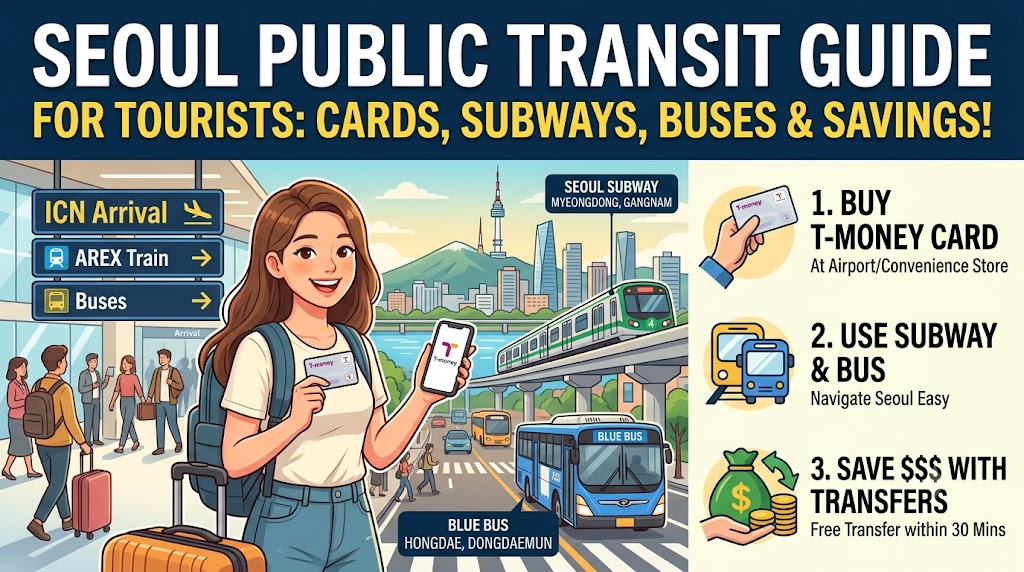
Seoul has one of the most efficient, clean, and extensive public transportation systems in the world. As a foreign tourist, getting around the city using subways and buses is not only cheap but also incredibly easy once you know the basics.
This complete guide will explain everything you need to know about traveling between major hotspots in Seoul, including how to buy transit cards, and a secret tip on how to save your travel budget using the Korean transit transfer system.
💳 1. Getting Your Transit Card (Crucial First Step)
While you can buy single-journey tickets, it is highly recommended to get a rechargeable transit card. Korea is virtually a cashless society when it comes to public transport!
Option A: T-Money Card (The Classic Choice)
The T-Money card is the standard transit card used all over South Korea.
- Where to Buy: Any convenience store (CU, GS25, 7-Eleven) or subway station vending machines.
- Cost: ₩3,000 – ₩5,000 for the empty card.
- How to Top-Up: You must use CASH (KRW) to recharge it at convenience stores or ticket machines inside subway stations.
- Best For: Travelers visiting multiple cities in Korea (Busan, Jeju, etc.) or those staying for a long time.
Option B: The Climate Card Tourist Pass (Highly Recommended!)
Recently introduced for tourists, the Climate Card (기후동행카드) offers unlimited rides on subways and buses within Seoul.
- Tourist Short-Term Passes:
- 1-Day: ₩5,000 | 2-Day: ₩8,000 | 3-Day: ₩10,000 | 5-Day: ₩15,000
- Where to Buy: Information centers in major subway stations (Line 2 to 8) or convenience stores along the subway lines.
- Best For: Tourists who plan to travel extensively around Seoul in a few days. (Note: It does not cover the Shinbundang Line or trips outside of Seoul).
🚇 2. How to Use the Transit System & Save Money
❗ The Golden Rule: Tapping In and Out
Whether you use a T-Money card or a Climate Card, you must always tap your card when you get ON, and tap it again when you get OFF. Failing to tap off will result in a penalty charge (double fare) on your next ride, and you will lose your free transfer discount.
💰 How to Save Money: The "Transfer Discount" System
Korea has an amazing integrated fare system. If you use a T-Money card, you do not have to pay the full fare again when transferring between different modes of transport. You only pay for the total distance traveled.
Here is how you can maximize this benefit and save your money:
- The 30-Minute Rule: To get the free or discounted transfer, you must tap onto your next bus or subway within 30 minutes after tapping out of your previous ride. (Bonus: From 9:00 PM to 7:00 AM the next day, this transfer window is extended to 60 minutes!)
- Transfer Limit: You can transfer up to 4 times (5 rides in total) in a single journey.
- Eligible Transfers:
- Subway ➔ Bus (O)
- Bus ➔ Subway (O)
- Bus ➔ Different Bus Route (O)
- Non-Eligible Transfers: You cannot get a discount if you transfer to the exact same bus route number, or if you exit a subway station gate and re-enter the same subway station.
Example of Money Saved:
- Without Transfer Discount (Cash/Single Ticket): Subway to Hongdae (₩1,400) + Bus to the hotel (₩1,500) = Total ₩2,900
- With T-Money Transfer Discount: Subway to Hongdae (₩1,400) + Bus transfer within 30 mins (₩0) = Total ₩1,400 (You save more than 50%!)
📍 3. Traveling Between Seoul's Major Hotspots
Here is how you can easily travel between the most popular tourist destinations in Seoul using the subway system.
| From | To | Best Route (Subway) | Approx. Time |
| Myeongdong | Hongdae | Line 4 (Myeongdong) ➔ Transfer at Seoul Station to AREX / Line 2 ➔ Hongik Univ. Station | 25 Mins |
| Hongdae | Gyeongbokgung | Line 2 (Hongik Univ.) ➔ Transfer at Euljiro 3(sam)-ga to Line 3 ➔ Gyeongbokgung Station | 30 Mins |
| Gangnam | Myeongdong | Line 2 (Gangnam) ➔ Transfer at Sadang to Line 4 ➔ Myeongdong Station | 35 Mins |
| Seoul Station | Dongdaemun | Take Line 4 directly from Seoul Station to Dongdaemun Station | 10 Mins |
💡 Pro Tip for Navigating: Google Maps does not provide accurate walking directions in South Korea due to national security laws. Please download Naver Map or KakaoMap (both available in English) for flawless public transit and walking navigation!
🚌 4. Understanding Seoul City Buses
Seoul buses are color-coded to help you understand their routes at a glance:
- 🔵 Blue Buses: Connect different districts across the city (Main line).
- 🟢 Green Buses: Travel shorter distances within specific neighborhoods and connect to subway stations.
- 🔴 Red Buses: Express buses connecting Seoul to suburban cities (e.g., Suwon, Incheon).
- 🟡 Yellow Buses: Circular routes going around specific central areas (like Namsan Tower).
Using buses is a great way to see the city above ground. Remember to hold on tight, and don't forget to tap out to secure your transfer discount!
Enjoy your stress-free travels around Seoul! If you have any questions about specific routes or transit cards, leave a comment below.
https://minaleedaddy.tistory.com/5
How to Navigate Seoul: The Easy and Cheap Public Transit & Card Guide for Foreign Tourists
Seoul has one of the most efficient, clean, and extensive public transportation systems in the world. As a foreign tourist, getting around the city using subways and buses is not only cheap but also incredibly easy once you know the basics.This complete gu
minaleedaddy.tistory.com
https://minaleedaddy.tistory.com/7
How to Travel from Incheon Airport to Busan: Flights vs. KTX Train Guide
Arriving at Incheon International Airport (ICN) and planning to visit the beautiful coastal city of Busan? You have two fantastic options depending on your travel style!Whether you want to head straight to Busan via a quick domestic flight, or spend a few
minaleedaddy.tistory.com
🗼 3 Must-Know Korean Phrases for You
1. Where can I buy / recharge a T-money card?
티머니 카드 어디서 사고 충전해요?
Timoni kadeu eodiseo sago chungjeonhaeyo?
2. Which exit / platform is it for this station?
이 역에서 몇 번 출구 / 몇 번 승강장이에요?
I yeogeseo myeot beon chulgu / myeot beon seunggangjangieyo?
3. Does this bus go to ...? Where do I transfer?
이 버스 ... 가요? 환승은 어디서 해요?
I beoseu ... gayo? Hwanseungeun eodiseo haeyo?